These are done after lunch to ensure the telescopes, instruments and image detectors (usually a CCD camera) are performing correctly. If everything is ok, an entry is made in the telescope log book formally handing over the systems for observing.
This also includes the mundane job of filling the CCD camera cryostats with liquid nitrogen (LN2). The INT has only one CCD camera in use. Either up at the prime focus for wide field imaging or mounted on the Intermediate Dispersion Spectrograph (IDS) at the Cassegrain focus. The WHT depending on what instruments are in use may have several cryostats that need to be filled and this can be quite time consuming.
Update Since I wrote this page back in 2006, an LN2 AUTO FILLING system has been installed on the WHT. This is connected by the Observing Support Assistant (OSA) at the end of the night and left running during the day. The OSA (in the WHT) is now the only staff member who is on site at night.
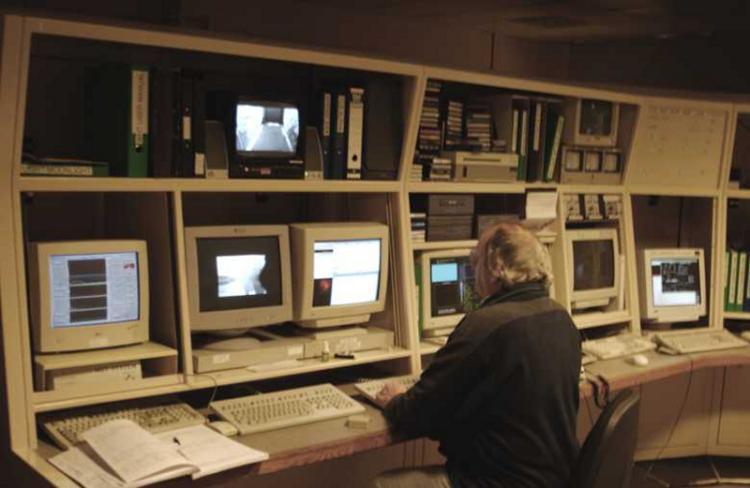
In the WHT control room (March 2002)
Me loading coordinate (RA and DEC) values into the Telescope Control System (TCS) to ensure that the telescope moves to the selected position and that finally tracking is achieved. This test also moves the dome. Its not been unknown that the dome aperture and the telescope can end up in different positions due to a problem... Not good for observing!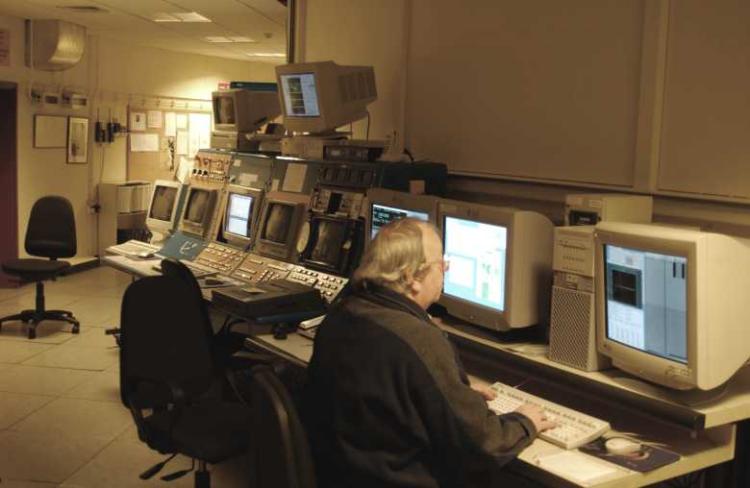
In the INT control room (March 2002)
Here I'm checking an image (a bias frame) from the prime focus Wide Field Camera. The image readout from the four large format CCD chips can be seen on the display monitor to the right.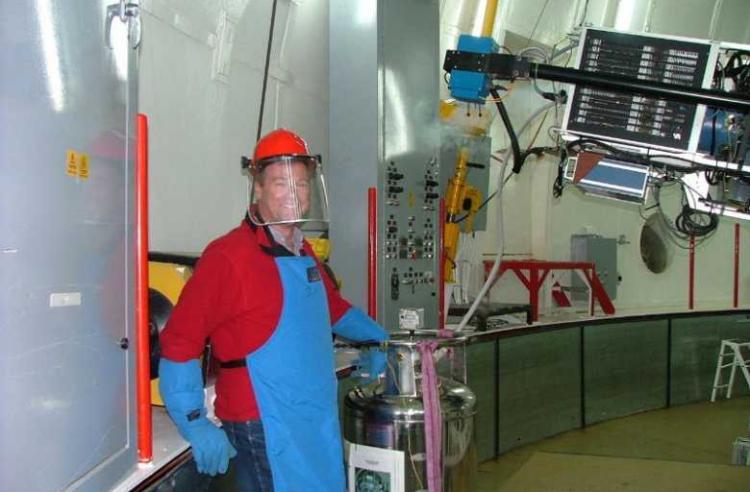
Renee filling the INT Wide Field Camera cryostat with liquid nitrogen (July 2004)
The camera cryostats are topped up three times a day. By the observer (or the Telescope Operator in the WHT) before opening the dome. At dawn after the nights observing and after lunch by a member of the engineering staff. Its very important that the CCD cameras don't warm up else thermal noise will be introduced and saturate the images.Click here to read about some of my experiences working as a night duty engineer.